Get Your AC Ready for Summer: The Pre-Season Checklist Every Ventura County Homeowner Should Run in May
Getting your AC ready for summer takes about an hour of homeowner effort plus one professional tune-up, and May is the month to do both. The homeowner side covers six tasks: replacing the filter, clearing and rinsing the outdoor condenser, checking thermostat settings, running a test cycle, flushing the condensate drain, and opening every supply register. The professional side covers what those tasks cannot: refrigerant charge, electrical components, and coil condition.
Here is why timing matters in our part of the world. Ventura County systems sit mostly idle from October through May. Marine layer mornings and mild afternoons mean your air conditioner may not run a full cycle for six months, and problems that developed quietly over winter stay invisible until the first inland heat spike sends Thousand Oaks, Simi Valley, and Moorpark into the 90s. At that point, every HVAC schedule in the county fills up at once. The homeowners who ran this checklist in May are not the ones waiting for a repair slot in July.
After 50 years of servicing homes from Moorpark to Malibu, this is the exact pre-season routine we recommend.
The Six Tasks You Can Do Yourself
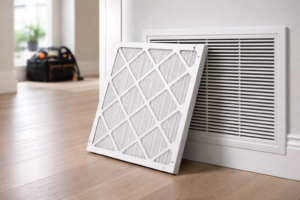
1. Replace the Air Filter
Start here, because a clogged filter undermines everything else. Restricted return airflow makes the system run longer, cool less, and in bad cases freeze the evaporator coil solid.
Install a fresh filter and check the arrow on the frame points toward the blower. For most homes, a MERV 8 to 11 filter balances filtration and airflow well. If wildfire smoke or allergies are a concern in your household, we covered filtration choices in depth in our recent guide to HVAC air filtration in Ventura County. Set a reminder to check it again in 60 days, because summer dust loads shorten filter life.
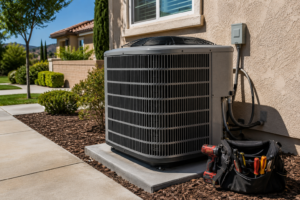
2. Clear and Rinse the Outdoor Condenser
Your condenser spent the winter collecting leaves, cottonwood fluff, and dirt, and homes near open space in Moorpark, Newbury Park, and Camarillo collect more than most. A matted coil cannot reject heat, which raises head pressure, cuts cooling capacity, and inflates your electric bill all at once.
Shut off power at the disconnect box next to the unit. Pull weeds and trim vegetation to give the unit at least two feet of clearance on all sides. Then rinse the coil fins gently with a garden hose from the outside, top to bottom. Skip the pressure washer, which folds fins flat and does permanent damage. If the fins are visibly crushed or the grime does not rinse off, leave deeper cleaning to a technician.
3. Check the Thermostat Before You Need It
Swap batteries if your model uses them, confirm the system responds to a COOL call, and set the fan to AUTO rather than ON.
If you are on an SCE time-of-use rate plan, May is also the month to build your summer schedule: pre-cool the house in the early afternoon and let the setpoint drift up during the 4 to 9 p.m. peak window. A programmable or smart thermostat doing this automatically is one of the few genuinely free wins in home cooling.
4. Run a Full Test Cycle on a Mild Day
Do not let the first heat wave be your system’s first start of the year. Pick a warm May afternoon and run the AC for 20 to 30 minutes.
You are listening and feeling for three things. The outdoor unit should start smoothly, without repeated clicking, humming, or a delayed fan. The air at the registers should feel distinctly cold, roughly 15 to 20 degrees cooler than the return air near your filter. And the system should reach setpoint and shut off rather than running endlessly. Grinding, burning smells, ice on the copper lines, or weak cool air are all reasons to stop and book a repair visit now, while schedules are still open.
5. Flush the Condensate Drain Line
A clogged condensate drain is one of the most common no-cool calls of every summer, and one of the most preventable. Algae builds in the line over winter, the drain backs up, and the float switch shuts the whole system down, usually on a hot afternoon.
Find the PVC drain line near the indoor air handler, open the access tee, and pour in a cup of distilled white vinegar. Repeat monthly through the cooling season. If you see standing water in the drain pan or the line has never been cleared, have it professionally vacuumed and treated before it becomes a shutdown.
6. Open Every Supply Register
Walk the house and confirm every supply register is open and unblocked by furniture or rugs. And resist the old advice about closing registers in unused rooms. Modern systems are designed for a fixed airflow; closing registers raises static pressure, stresses the blower, and can push a marginal system toward coil freeze. If certain rooms consistently run hot or cold, that is a duct balancing or zoning conversation, not a register-closing one.
What to Leave for the Professional Tune-Up
The checklist above handles airflow and housekeeping. It cannot verify the things that actually cause mid-summer breakdowns: whether the refrigerant charge is correct, whether the run capacitor is still within its rated tolerance, whether the contactor is pitted, and whether motor amp draws are climbing toward failure. Those require gauges, a multimeter, and someone certified to use them.
That is the job of a spring tune-up, and May is the sweet spot to schedule one: late enough that the cooling season is real, early enough that appointment books are not yet slammed. Members of our maintenance program get this visit automatically every spring, plus a fall heating check and priority scheduling during the peak weeks when it matters most.
One honest note on aging systems: if your air conditioner is 15 or more years old, use this pre-season visit to get a clear read on its condition before summer, not during it. Repair costs on older refrigerant platforms are rising, and heat wave weeks are the worst possible time to make a rushed replacement decision. A free onsite changeout consultation in May gives you numbers and options while you still have time to think.
Book Your Spring Tune-Up While the Schedule Is Open
Stuart Rose Heating & Air Conditioning has been getting Ventura and Los Angeles County homes ready for summer since 1973. Our licensed technicians perform complete pre-season tune-ups with documented test results, flat-rate pricing, and honest recommendations from a team that has never worked on commission.
Call (805) 590-4111 or schedule service online and walk into summer knowing your system is ready, from Moorpark to Malibu.