Is Skipping Your AC Tune-Up Costing You? What a Real Maintenance Visit Includes
A legitimate AC tune-up is a 60 to 90 minute technical inspection that verifies refrigerant charge, tests electrical components under load, cleans both coils, treats the condensate system, and measures system performance against manufacturer specifications. It is not a filter change and a hose-down. Skipping it costs the average homeowner in three ways: higher energy bills from degraded efficiency, preventable breakdowns during peak season, and a shorter equipment lifespan that pulls a five-figure replacement years closer.
The word “tune-up” has a credibility problem in this industry, and honestly, some companies earned it. A $39 special that exists purely to get a commissioned salesperson into your attic is not maintenance. So let’s define what a real visit includes, what neglect actually costs in a Ventura County climate, and why every August we end up explaining this to homeowners standing in hot houses.
Why August Is When Skipped Maintenance Sends the Bill
Coastal Southern California has a specific failure pattern. Our systems sit mostly idle from October through May, then get hammered when inland valley temperatures spike in July and August. Components that degraded quietly during the off-season, a weakening capacitor, a low refrigerant charge, a matted condenser coil, all fail at once under sustained load.
That is why the busiest repair weeks of our year land in August, and why homeowners who skipped a spring tune-up end up competing for schedule slots during a heat wave. The capacitor that would have been flagged and replaced in April for a modest cost instead takes out an afternoon of cooling in August, and sometimes takes the compressor’s lifespan down with it.
The pattern is predictable enough that we built our maintenance program around it: biannual tune-ups timed to spring and fall, with priority scheduling for members even during the weeks when the schedule is slammed.
What a Real AC Tune-Up Includes
If a company cannot tell you specifically what their tune-up covers, that tells you something. Here is what a legitimate maintenance visit on a residential system includes.
Refrigerant charge verification. The technician measures superheat and subcooling with gauges to confirm the system holds the correct charge. A system just 10 percent low on refrigerant loses a meaningful share of its cooling capacity and runs longer cycles to compensate. Low charge also signals a leak that is far cheaper to address early.
Electrical testing under load. Capacitors are tested against their rated microfarads, contactor points are inspected for pitting, wire connections are tightened, and motor amp draws are measured against nameplate ratings. This is where next month’s breakdown gets caught this month. A capacitor reading below spec is the single most common heat wave failure we prevent.
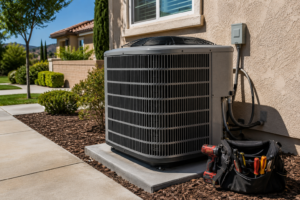
Condenser coil cleaning. The outdoor coil is cleaned so it can actually reject heat. Homes in Moorpark, Simi Valley, and Camarillo near open space or agricultural land accumulate serious debris loads, and a dirty condenser coil raises head pressure, cuts capacity, and drives up energy use simultaneously.
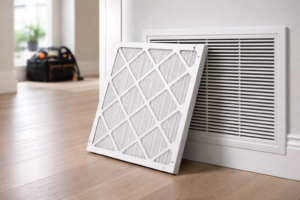
Evaporator coil and blower inspection. Airflow is the other half of the equation. The technician inspects the indoor coil, blower wheel, and filter, and checks that static pressure and airflow are in a healthy range. Restricted airflow freezes coils and burns out blower motors.
Condensate drain treatment. The condensate line is cleared and treated to prevent algae clogs. A clogged drain trips the float switch and shuts your system down entirely, which is one of the most common and most preventable no-cool calls of the summer.
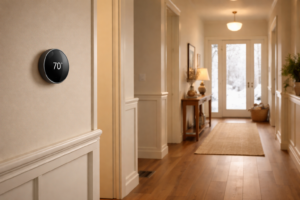
Thermostat and system operation check. Temperature split across the coil is measured, the thermostat is calibrated, and the full cooling cycle is verified from call to shutdown.
A written report. You should finish every visit knowing exactly what was measured, what is healthy, and what is trending toward failure, with no pressure attached. We put test results and recommendations in your hands at the end of every visit, and because our technicians are not commission-based, a recommendation means the measurement justified it.
The Real Cost of Skipping It
The math on maintenance is not complicated, but it is invisible until it is not.
Efficiency loss compounds quietly. Dirty coils, low charge, and weak airflow each shave cooling capacity while adding run time. Stack them and a neglected system can consume noticeably more electricity to deliver worse comfort. Under SCE’s time-of-use rates, longer run cycles during 4 to 9 p.m. peak windows are the most expensive kind of waste a home can produce.
Small failures become large ones. A weak capacitor is a quick, inexpensive swap. The hard-starting compressor it creates is not. A slow refrigerant leak caught at a tune-up is a repair; the same leak discovered after a summer of running undercharged may arrive alongside compressor damage on a system old enough that replacement enters the conversation. Our repair page covers what that diagnostic process looks like when things do break, but the cheaper version of that visit is the one that happens before the failure. Repair and service details here.
Your warranty may depend on it. Most manufacturers, Carrier included, require documented regular maintenance to keep parts warranties valid. Skipping tune-ups on a system still under warranty risks converting a covered failure into an out-of-pocket one.
Lifespan is the biggest line item. Well-maintained systems in our mild coastal climate routinely reach 15 to 20 years. Neglected systems make the repair-or-replace decision show up early. When the difference between those outcomes is a five-figure changeout arriving five years sooner, two maintenance visits a year is the cheapest insurance in homeownership. When replacement genuinely is the right move, we will tell you straight and walk you through options with a free onsite changeout consult.
Tune-Up vs. Maintenance Plan: Which Makes Sense?
A one-time tune-up is better than nothing, and if your system has not been touched in years, start there.
A maintenance program makes sense once you look at how the value stacks. Our residential members receive tune-ups twice a year, cooling systems checked in spring and heating checked in fall, so both sides of the system get inspected before their heavy season. Members also receive priority scheduling, which matters most in exactly the weeks you would need it: when a heat wave has every HVAC company in Ventura County booked out and non-members are waiting.
For commercial properties, the calculus is steeper. Rooftop units on offices, churches, and multi-tenant buildings endure far more runtime, which is why our commercial clients receive quarterly maintenance rather than biannual.
Get on the Schedule Before the Next Heat Wave
Stuart Rose Heating & Air Conditioning has maintained heating and cooling systems across Ventura and Los Angeles Counties since 1973. Our licensed technicians perform complete tune-ups with documented test results, flat-rate pricing, and honest recommendations, because we are not a commission-based company and never have been.
Call (805) 590-4111 or schedule your tune-up online, or ask about our maintenance program and lock in biannual service with priority scheduling from Moorpark to Malibu.