Indoor Air Quality in Thousand Oaks: What Actually Helps (and What to Do First)
If your home in Thousand Oaks or Moorpark gets dusty fast, smells a little musty after the system runs, or leaves you feeling “stuffy” indoors, you are not alone. Ventura County homes deal with a mix of seasonal pollen, outdoor dust, wildfire smoke events, and everyday indoor sources like cooking, pets, and older duct systems. The good news is you do not have to guess. A few practical checks can tell you whether your issue is filtration, airflow, humidity, or a need for air purification.
This guide breaks down real-world indoor air quality improvements for Thousand Oaks, Moorpark, and Ventura County, with a focus on solutions that may help reduce triggers and improve comfort. It also explains where air scrubbers and UV systems fit in, and how to avoid spending money on upgrades that do not match the problem.
Why indoor air quality problems show up in Thousand Oaks and Moorpark
Indoor air quality is rarely caused by one thing. In this area, it is usually a combination:
- Outdoor dust and pollen that gets pulled indoors through doors, windows, attic leaks, and return air pathways
- High HVAC run time during hotter periods, which circulates airborne particles more often
- Older ductwork that may have gaps, insulation breakdown, or accumulated debris
- Homes that feel “tight” where fresh air does not move through naturally, especially after renovations or window upgrades
When indoor air is not being filtered well, not being moved well, or not being refreshed well, you notice it as dust buildup, odors, uneven comfort, or frequent filter clogging.
The most common indoor air quality complaints we hear locally
1) Dust buildup that returns quickly
If you dust and within days it is back, the issue is often one of these:
- A filter that is not capturing smaller particles
- Air bypass around the filter because the filter slot or cabinet is not sealed well
- Duct leakage pulling dusty air from attics, crawlspaces, or wall cavities
- Too much return air velocity creating turbulence and lifting settled dust
2) Allergy symptoms indoors
Many clients describe symptoms that feel worse at home than outside, especially in spring. Better filtration and targeted purification may help reduce triggers and improve comfort, but only if airflow is correct and the filter setup is not allowing bypass.
3) Musty odors when the system runs
Musty smells usually come from moisture plus organic material somewhere in the system. It can be in the evaporator coil area, drain pan, duct insulation, or a return air pathway pulling in odors. The right fix depends on where the odor is generated and how air is moving.
4) Dirty vents and frequent filter clogging
This can happen when:
- The system is moving a lot of air through a restrictive filter
- There is duct leakage or construction dust
- The blower is dirty
- Return air is pulling from dusty areas (garage leaks and attic leakage are common culprits)
5) Uneven airflow and hot/cold rooms
This is an HVAC comfort issue that affects air quality, too. If certain rooms do not get enough airflow, air gets stagnant. Fixing airflow (balancing, return air improvements, duct repairs) can improve both comfort and perceived air freshness.
The “do this first” indoor air quality checklist
Before you buy anything, start with the basics. These steps solve a lot of problems and make every upgrade work better.
Step 1: Make sure the filter setup is actually doing its job
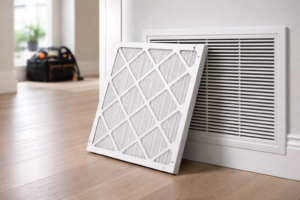
- Use the right size filter (a loose fit can allow air to slip around the edges)
- Replace it on a schedule based on your home, not the calendar
- If you are clogging filters quickly, do not just keep upgrading to a more restrictive filter. That can reduce airflow and make comfort worse.
Step 2: Check airflow and duct integrity
If you have hot/cold rooms or weak airflow, air quality upgrades will not feel as effective. A system that is starved for airflow can also create odor and moisture issues around the coil area. This is where a technician-led evaluation matters.
Step 3: Identify the type of problem before picking the solution
- Particles (dust/pollen): filtration and sealing
- Odors and VOCs: purification
- Musty smell and microbial concerns: moisture control plus purification (often UV is a fit)
- Stale air: ventilation strategy (sometimes as simple as correcting return air and airflow balance)
Filtration vs purification: what is the difference?
Filtration (captures particles)
Filtration is about catching airborne particles as air moves through the system. A better filter may reduce dust and pollen, but it has limits, and it must be matched to the system so airflow stays healthy.
Where filtration wins:
- Dust buildup
- Pollen
- Pet dander
- Everyday household particles
Purification (targets smaller particles and certain odors)
Purification is designed to address what filtration misses or what is not purely a particle problem. This is where air scrubbers and UV systems can be valuable, especially when odors or musty smells are part of the complaint.
Where purification often helps most:
- Musty odors
- “Stuffy” air feeling
- Homes with recurring odor complaints
- Households wanting a stronger whole-home approach
When air scrubbers are a good fit in Thousand Oaks and Ventura County homes
Air scrubbers are popular because they address the “I want the air to feel cleaner” problem that filtration alone does not always solve. In a whole-home setup, the unit is installed in the HVAC system so it can treat air as it circulates.
Air scrubbers may help when you notice:
- Persistent odors even after cleaning
- Cooking smells that linger
- A home that feels stale even with a good filter
- Musty “system smell” that returns
What a good install includes:
- Proper placement in the duct system
- Confirmation that airflow is correct
- Filter setup that still captures particles well, since purification is not a replacement for filtration
When UV systems are a strong option (especially for musty odors)
UV systems are often used to address microbial growth risks in the HVAC environment, particularly near the coil area where moisture can be present. If you get a musty smell when the system runs, UV can be part of the solution, but it should not be installed as a guess.
UV systems may help reduce triggers and improve comfort when:
- Musty odors return quickly
- There is a history of moisture around the coil or drain
- The smell is strongest right when the system kicks on
A technician should also confirm that drainage, airflow, and coil conditions are addressed. If you solve the moisture and airflow factors, UV tends to perform better and last longer.
The most overlooked upgrade: sealing and filter cabinet improvements
If your system is pulling air around the filter instead of through it, you can install the best filter in the world and still be disappointed. Small gaps in a filter rack, return plenum, or cabinet can act like a shortcut for dusty air.
In many homes, improving the filter cabinet fit and sealing return air pathways is one of the fastest ways to reduce dust and extend filter life. It also supports every purification upgrade you add later.
What about duct cleaning?
Duct cleaning can be helpful in specific cases, but it is not a universal solution. If your ducts have construction debris, heavy dust accumulation, or an odor source, cleaning can make sense. If the main issue is poor filtration, duct leakage, or airflow imbalance, cleaning without fixing the cause often leads to the problem coming right back.
A better approach is:
- Diagnose airflow and return air issues
- Fix bypass and leakage
- Then clean if needed, once you are confident the system will stay cleaner
A simple decision guide for Thousand Oaks and Moorpark homeowners
If you want a practical way to choose the next step, use this:
If your main problem is dust and allergies
Start with:
- Correct filter sizing and fit
- A filtration upgrade that matches your system
- Sealing bypass points
- Airflow evaluation if certain rooms are stagnant
Then consider:
- Air scrubber if the home still feels “stuffy” or dusty after airflow and filtration are handled
If your main problem is musty odors
Start with:
- HVAC inspection focused on coil area, drain, and airflow
- Identify where moisture is coming from
Then consider:
- UV system (especially if odors are tied to system operation)
- Air scrubber if odors linger throughout the home
If your main problem is uneven airflow and hot/cold rooms
Start with:
- An HVAC service visit to evaluate airflow, duct balance, and return air
- Fix comfort first, since comfort problems create stagnant zones that feel like air quality problems
Then consider:
- Purification upgrades after airflow is corrected
Why working with technicians, not salespeople, matters for IAQ
Indoor air quality upgrades are easy to oversell because the benefits can sound universal. In reality, the best results come from matching the solution to the problem in your home. That is why Stuart Rose emphasizes a technician-first approach. The goal is to diagnose, explain options clearly, and recommend what fits your home, not what is trendy.
As a family-owned company serving the area since 1973, Stuart Rose has seen the same pattern over and over: when airflow, filtration fit, and system condition are handled first, IAQ upgrades like air scrubbers and UV systems tend to deliver the comfort improvements homeowners are hoping for.
Ready to improve indoor air quality in Thousand Oaks or Moorpark?
If you are dealing with dust buildup, allergy symptoms indoors, musty odors, frequent filter clogging, or uneven airflow, the fastest path forward is an in-home evaluation. We will look at the system, airflow, and filtration setup, then walk you through options like air scrubbers and UV systems if they are a fit.
Call to discuss options or schedule an in-home evaluation. If you are ready to take the next step, schedule a free estimate for IAQ upgrades.